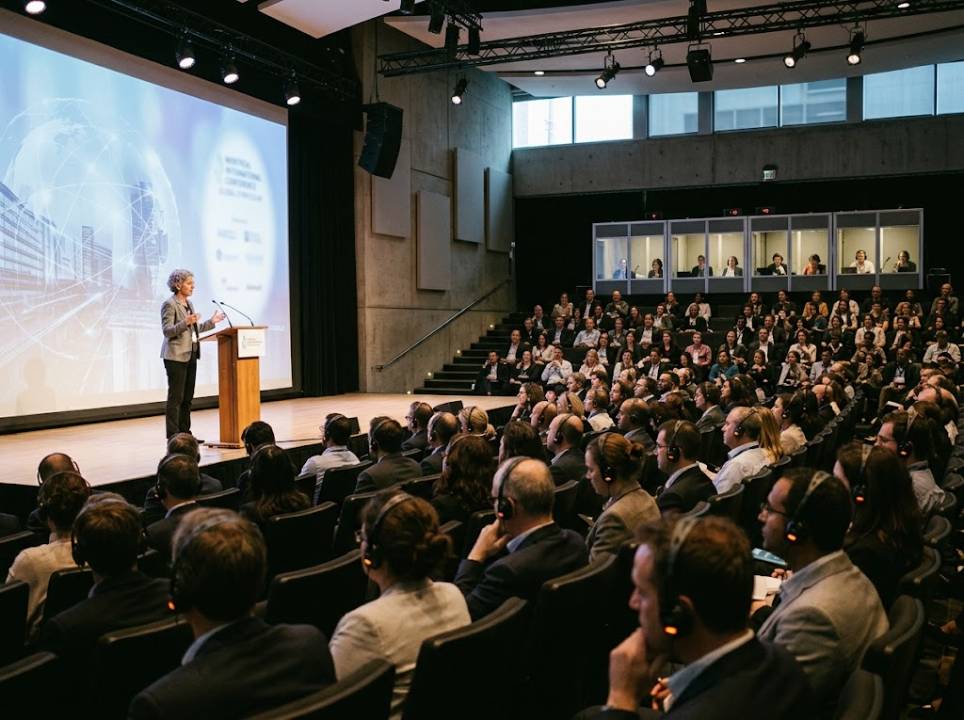
A bilingual conference sounds simple on paper. Book a venue, invite speakers, hire interpreters, send the invitations. In practice, organisers of French-English events quickly discover a long list of language decisions: which sessions need interpreting, which documents must exist in both languages, how to handle questions from the floor, what to do when a speaker switches language halfway through a sentence.
Get these decisions right and delegates barely notice the language barrier. Get them wrong and half the room spends the day confused. Here is how to plan a French-English conference without language gaps.
Start with your audience
Before booking anything, understand who is coming. Are most delegates bilingual, or do large groups speak only French or only English? Are French speakers mainly from France, Quebec, Belgium, Switzerland or Africa? The answers shape everything, from interpreting modes to the variety of French used in printed materials.
Language planning begins with a delegate profile, not with a quote from an interpreting agency.
Choosing the interpreting mode
For plenary sessions with large audiences, simultaneous interpretation is the standard. Interpreters work in soundproof booths, delegates listen through headsets, and the programme runs without delay. For smaller workshops, consecutive interpreting or whispered interpreting may be enough. Hybrid events add remote interpreting platforms so that online participants can choose their language channel.
Typical setups include:
- Two interpreters per booth for each language direction, swapping every thirty minutes
- Headsets and receivers for all delegates who need them
- Technical staff to manage sound, channels and streaming
- A briefing session with interpreters before the event
Translate the written materials early
Interpreting covers the spoken word, but conferences produce a surprising amount of text: invitations, websites, programmes, speaker bios, badges, signage, presentations, press releases and follow-up reports. Many organisers commission english to french translation services for the core materials weeks in advance.
This has a hidden benefit. Interpreters prepare from the same translated programme and terminology, so what delegates hear in their headsets matches what they read on the screen and in the handbook.
Presentations are the weak spot
Speakers often send slides at the last minute, in one language only. Encourage them to submit presentations early so that key slides can be translated or at least summarised. A bilingual title and key points on each slide help the whole audience follow, even with interpreting.
Ask speakers to avoid reading dense scripts at high speed. Fast reading is the hardest thing for interpreters to render accurately.
Handling questions and discussions
Panel discussions and Q&A sessions are where bilingual events succeed or fail. Provide microphones for every speaker, including audience members, so interpreters can hear clearly. Ask moderators to repeat questions briefly and to give the floor in a structured way. Spontaneous cross-talk without microphones cannot be interpreted.
After the event
The work continues after the applause. Minutes, reports, recorded sessions and follow-up communications all need to reach both language communities. French to english translation services are often needed for sessions held mainly in French, so that English-speaking partners and funders receive complete summaries.
More than two languages
Many international events start as bilingual and grow. A European forum might add German for delegates from Austria and Switzerland, supported by german to english translation services for printed materials. Humanitarian or public-sector conferences increasingly add Ukrainian, and a reliable ukrainian translation of key documents helps displaced participants and partner organisations take part fully.
Budgeting realistically
Interpreting is usually priced per interpreter per day or half day, plus equipment, travel and technical staff. Translation is priced per word. Build the budget from the programme: number of days, parallel sessions, language pairs and volume of materials. Cutting interpreters to save money often backfires, because tired interpreters make mistakes and sessions overrun.
A planning timeline
- Three to six months before: define languages, book interpreters and equipment
- Two months before: translate invitations, website and programme
- One month before: collect presentations and speaker notes
- One week before: brief interpreters and test equipment
- After the event: translate reports and follow-up materials
Quebec, France or Africa?
French is spoken very differently across the world. A delegation from Montreal will notice if every document uses Parisian expressions, while participants from Dakar or Abidjan may use terms that sound unusual in Brussels. Interpreters and translators familiar with these varieties adapt vocabulary, tone and examples so that no group feels like an afterthought.
Respecting regional varieties of French is a small detail that delegates remember. Tell your language provider where your French-speaking participants come from, and ask for linguists with matching experience.
Accessibility for everyone
Inclusive events also consider participants with hearing impairments. Live captioning in both languages, sign language interpreting and accessible documents make the conference open to more people. These services need the same early planning as interpreting, because qualified professionals are often booked months ahead, especially during the busy spring and autumn conference seasons.
Final thoughts
A truly bilingual conference treats both languages as equals. When interpreting, translation and speaker preparation are planned together, French and English delegates enjoy the same experience, and the event achieves what it set out to do: bring people together across languages.